Picture this: two gamers locked in a heated Fortnite match, a movie streaming in 4K on the TV screen, and someone else deep into a video call for work or school. Suddenly, the “fast Internet” you’re paying for feels sluggish and unresponsive. Even many high-speed Mbps Internet plans can start to show cracks when the whole family is online.
Our research into the 50 most popular multiplayer video games found that in busy households, total Internet demand often exceeds the available download and upload capacity. This can easily overwhelm many standard broadband packages—especially traditional Internet lines where bandwidth is shared among neighbors and can be affected by weather conditions.
Modern multiplayer games are not only bigger in size but also demand more real-time data exchange. Gone are the days when only download speed mattered for grabbing updates or installing new maps.
Now, upload speed plays a starring role. Every single movement, command, and voice chat has to shoot back to the server instantly. When the upload pipeline is weak, players encounter lag, rubber-banding, and delayed responses that can wreck competitive play.
For gamers, streamers, and smart device users, most “starter” Internet plans simply don’t have enough speed to keep up.
Why “Internet Speed” and Upload Matter for Group Play
Online gaming is far more complex than many assume. It’s not just about how quickly you can download a game from the store; it’s about whether your connection can keep pace with constant, two-way communication between your devices and game servers.
Download speed (often called simply “Internet speed”) controls how fast data arrives at your device. That’s important for downloading patches, loading new content, or even streaming in-game music and videos. Internet providers love to advertise big download numbers, but they don’t tell the whole story.
Upload speed is the quiet workhorse. Every shot fired, button pressed, or word spoken through your mic is sent back upstream. If uploads can’t keep up, those actions show up late or not at all. That’s when matches stutter, characters teleport around the screen, and teammates complain they can’t hear you.
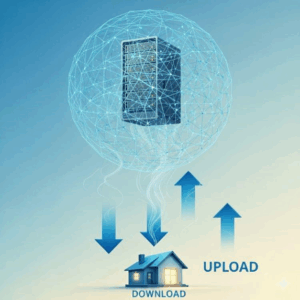
The problem is that most broadband plans still skimp upload speeds. A provider might advertise mid-range download speeds but offer only a fraction of that for uploads. That might be fine for one casual gamer, but add multiple players, streamers, and a few video calls, and the connection quickly falls apart.
Latency (or “ping”) is an issue that affects both downloading and uploading while online gaming. Low latency causes delays between a player’s actions and the game’s response. A steady 40 milliseconds ( ms) connection feels smooth, while an unstable 20–200 ms rollercoaster can make a fast-paced shooter unplayable. Stable latency is what makes a game feel fluid, responsive, and fair.
Two other download/upload problems, jitter and packet loss, are just as important for online gamers. Jitter occurs when latency variations slow the arrival of the data packets that drive game play. High jitter can lead to delayed player response as well as choppy audio and video. Packet loss occurs when data packets fail to reach their destination entirely, which can cause games to freeze or shut down.
Our Methodology
To put together our list of the top 50 multiplayer and co-op games, we looked at sales numbers, peak concurrent users, and daily active players. The titles that rose to the top—like Minecraft, League of Legends, Palworld, and Helldivers 2—showed how easily a modern gaming household could push an Internet connection to its limits.
We created a model to reflect “heavy load” homes: two gamers online at once, two TVs 4K, a video call running, and a handful of smart devices humming in the background. Whenever the model crossed entry-level Internet plans download or typical upload range upload, we marked that scenario as one likely to strain a typical broadband plan. Upload speed, often overlooked, turned out to be the limiting factor in many cases.
We also factored in real-world issues: peak-hour congestion, Wi-Fi vs. wired setups, and the difference between a one-off speed test and sustained performance. A household connection must hold steady over hours, not just look good for a snapshot. Planning multiple users at once is key. What feels fine for one solo gamer usually doesn’t scale for a busy family.
Based on our findings, we broke needs into three tiers:
- Casual: Light online gaming or solo play with occasional streaming
- Standard: Regular multiplayer sessions alongside multiple devices and streams
- Competitive: High-intensity, simultaneous usage—multiple gamers, streams, and video call at once
Even in a mid-sized home, simultaneous gaming, streaming, and smart device usage can quickly exceed what most entry-level broadband plans are built to support. When that happens, latency spikes and upload congestion become the biggest performance killers.
The Top 50 Games and Their Heavy-Load Bandwidth Needs
Even lighter titles can cause lag when several people are gaming, streaming, or conferencing at once. During busy hours, total household demand often climbs far beyond the comfort zone of standard broadband connections. Competitive multiplayer games, in particular, are extremely sensitive to both upload performance and latency.
Households using traditional cable Internet often notice slowdowns during peak times, since those connections share bandwidth and typically offer lower upload speeds. Fiber, by contrast, delivers symmetrical performance and greater stability, making it the ideal choice for gaming families and competitive players.

How Many Devices Are Really on Your Wi-Fi?
The average U.S. household now has more than 20 connected devices. Gaming is just one of many activities competing for bandwidth. During peak evening hours, it is common to see:
- Two gamers using entry-level Internet plans down and typical upload range up
- Two 4K streams using moderate upload capacity down
- One video call using limited upload capacity up and down
- Smart devices and phones contribute steady background usage on your network
Combined, these activities put significant strain on both download and upload capacity. The biggest issue tends to be uploading congestion, as cloud syncs, streaming, and large file transfers can easily overwhelm limited bandwidth.
Fiber vs. Cable Under Heavy Load
Cable remains the most common broadband option, but its upload speeds are often capped at just a fraction of its download rate. When multiple devices are online, that limitation can lead to lag and unstable gameplay.
Fiber, by contrast, offers symmetrical speeds—so a balanced, high-capacity connection plan gives plenty of headroom in both directions. Families with multiple gamers, streamers, and work-from-home users can all be online without stepping on one another. Fiber also provides more consistent latency, which is crucial for competitive play.
Tips for Gamers to Optimize Connection
To maintain sufficient Internet speeds, you may want to…
- Use wired Ethernet whenever possible.
- Schedule game updates overnight to avoid peak strain.
- Pause cloud backups while gaming.
- Run speed tests that show both upload and download before big matches.
- Use router Quality of Service (QoS) to prioritize gaming traffic. If using Wi-Fi, stick to 5 GHz and stay near the router.
Final Thoughts on Internet Speeds for Video Games
Our review of the top multiplayer games makes one thing clear: heavy-use households need more than a basic Internet plan. Nearly every title we tested exceeded the capabilities of entry-level broadband, especially when multiple players and devices were online. Upload speed, more than download, often becomes the hidden bottleneck.
For smooth group play, reliable ping, and room for future growth, households with multiple gamers should think beyond entry-level broadband. Clearwave Fiber provides 100% Fiber Internet that’s built to last. With symmetrical upload and download speeds, you never have to worry about your Internet slowing you down.